Beyond the Clipboard: Why We Inspect Backflow Preventers
· By Sunni Dowds · Compliance
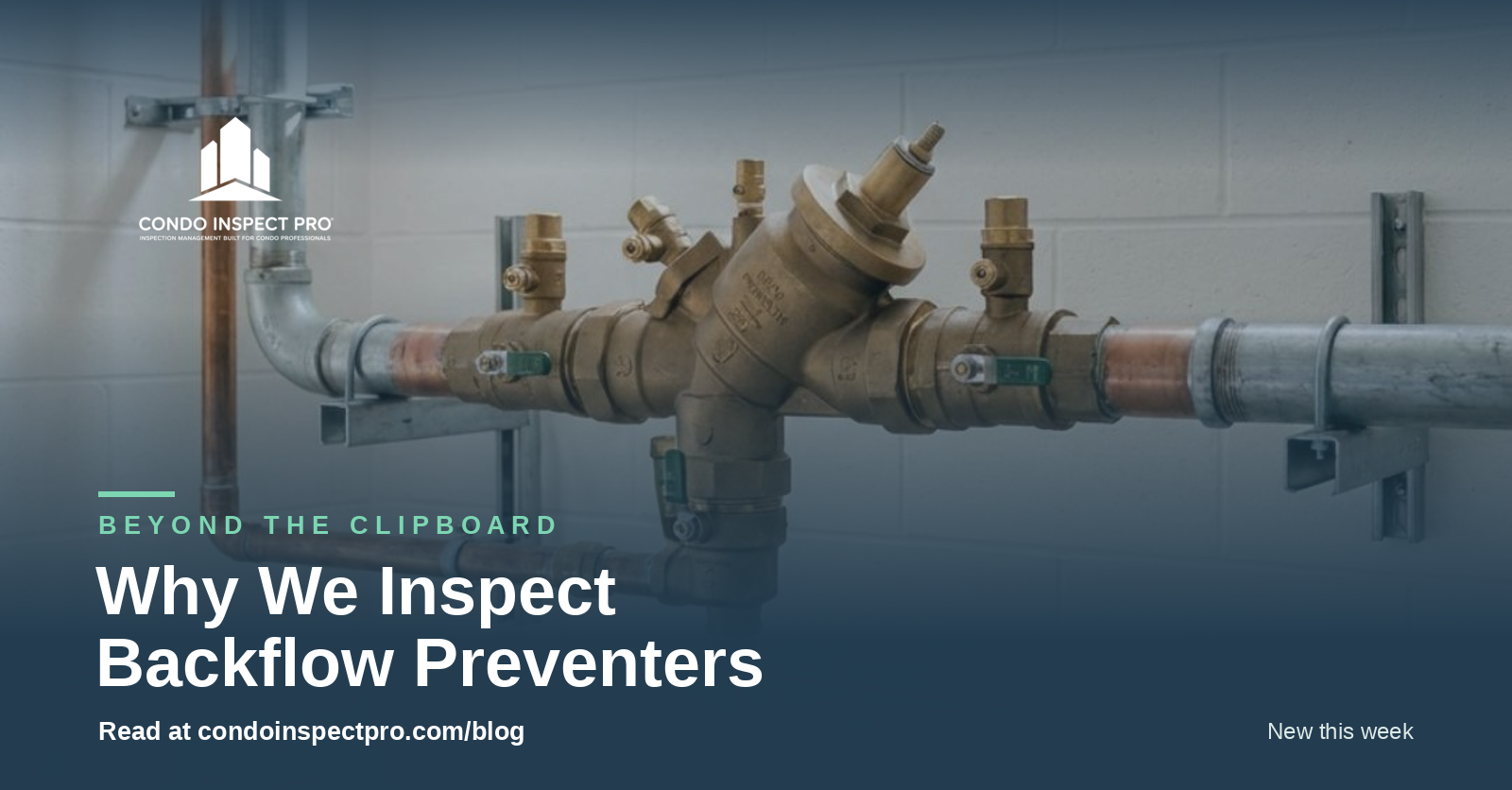
Most condominium managers can tell you the date of the last fire alarm verification. Far fewer can tell you when the building's backflow preventers were last tested, or how many the building has. The device sits in a mechanical room. It has no screen and no alarm. It works silently until the day it does not — and that is exactly why it gets missed.
Beyond the Clipboard · Compliance · By Sunni Dowds
Most condominium managers can tell you the date of the last fire alarm verification. Far fewer can tell you when the building's backflow preventers were last tested, or even how many the building has. The device sits in a mechanical room. It has no screen and no alarm. It works silently until the day it does not. That is exactly why it gets missed, and why a missed backflow test is one of the cleaner examples of work that happened with no record to prove it.
What a backflow preventer actually does
A backflow preventer is a one-way gate on a water line. Water is meant to flow in one direction: from the municipal main into the building and out to the fixtures. Two things can reverse that flow. Backsiphonage occurs when supply pressure drops — for example during a water main break or heavy firefighting demand — and a vacuum pulls water backward. Backpressure occurs when a downstream system such as a boiler or a pump pushes water back toward the supply.
When flow reverses, it carries whatever it has touched with it. The backflow preventer is the mechanical check that stops that reversal.
There is a distinction worth being precise about, because it changes who the device is protecting. The premise isolation assembly, sometimes called containment, sits at the building's service connection. Its job is to protect the municipal drinking water supply from contaminants that originate inside the building. Inside the building, separate isolation assemblies protect at specific hazards, closer to the source of risk. Both matter. Only together do they protect the public supply and the building's own potable water.
They are not only on the water main
This is where many programs fall short. Backflow assemblies are not a single device on the incoming water line. In a condominium they sit across several systems:
- Premise isolation at the main service — double check valve assemblies for moderate hazards, reduced pressure assemblies for severe hazards.
- Fire suppression and sprinkler lines, where water sits stagnant in the pipes for long periods.
- Boiler and chiller feeds and cooling towers, where water mixes with heat and chemicals.
- Property irrigation systems, where fertilizers and stagnant groundwater are the hazard.
A single building can have several testable assemblies, each on a different system, each with its own annual due date.
Who tests them, and what the manager owns
The test is not the manager's to perform. In Ontario, every testable assembly must be tested at least once a year by a qualified, certified backflow tester, and in many municipalities only a tester registered with the city may submit the report. The requirement is enforced through municipal cross-connection control by-laws, the Ontario Building Code, and the Ontario Fire Code, with testing performed to CSA B64.10.
What the corporation and the manager own is the oversight. Ensuring the test is done on schedule. Ensuring the report is filed with the municipality. Retaining the record — in Toronto for a minimum of seven years. The wrench belongs to the certified tester. The record belongs to the manager.
The test is not the manager's to perform. The record is.
What it costs to get this wrong
The consequences in Ontario are real and specific. A missed or failed test can bring a municipal order and daily fines. For persistent non-compliance, the municipality can disconnect the building's water service to protect the public supply. Under Toronto's water supply by-law, penalties can reach six figures, and municipalities such as Mississauga increase fines for repeat violations.
The financial penalty is not the worst case. In Stratford, Ontario, a single backflow incident allowed a contaminant into the municipal drinking water system. Roughly thirty thousand people were affected, some for days, and it was prosecuted under the Safe Drinking Water Act, 2002. That is the outcome the annual test exists to prevent.
The part most inspections miss
Here is the deeper reason we inspect, and it is the part a deficiency log will never capture. A backflow preventer has a service life. Internal seals and check springs wear. A device that passes this year can be near the end of its life and still pass — for now.
A real inspection does not only record pass or fail. It reads the state of the device against where it sits in its lifecycle, and it records one of three things:
- Working and within its expected life: note it and move on.
- Working but at or beyond its expected life: flag it, keep monitoring, and plan the rebuild before it fails.
- Failed: act.
The middle state is the one that separates an inspection from a walkthrough. It turns a building's equipment into a forecast instead of a series of disconnected pass/fail snapshots. That is what a maintenance program looks like. The certified tester sees the device. The manager's job is to make sure that observation is recorded against the device, in context, with the history behind it.
The record is the asset
The work usually gets done. The report usually gets emailed. Then it is glanced at and never filed against the device it covers, and twelve months later no one can produce it. The corporation is exposed not because it failed to test, but because it cannot prove it tested.
This is the gap Condo Inspect Pro is built to close. The Backflow Prevention Test template holds every device, its location, its system, and its annual due date. The certified report attaches to the device, with the date and the tester named. The platform tracks what is coming due and flags it before the deadline, and it holds the condition history — including the devices that are working today but moving toward a rebuild. When the municipality, the insurer, or the board asks, the answer is retrievable in seconds, not reconstructed from memory.
A backflow preventer is a small device. It is also a clean test of whether your documentation can keep up with what your building actually requires.
Frequently Asked Questions
How often do backflow preventers need testing in Ontario?
At least once a year, by a qualified, certified tester, with the report filed with the municipality. Confirm the interval and the registration and filing process with your local cross-connection control program.
Who is responsible for the building's backflow devices?
The condominium corporation is responsible for the devices on the private side of the water service, which in a condominium is the building. The board and the manager carry the obligation to ensure testing happens and the record is held.
What happens if a test is missed?
Consequences range from a municipal order and daily fines to disconnection of the building's water service for persistent non-compliance, and, in the event of an actual contamination incident, prosecution under the Safe Drinking Water Act.
Frequently Asked Questions
How often do backflow preventers need testing in Ontario?
At least once a year, by a qualified, certified tester, with the report filed with the municipality. The testing interval and registration requirements vary by municipality — confirm the specific process with your local cross-connection control program.
Who is responsible for the building's backflow devices?
The condominium corporation is responsible for the devices on the private side of the water service. The board and the licensed manager carry the obligation to ensure annual testing happens, that the certified report is filed with the municipality, and that the record is retained — in Toronto for a minimum of seven years.
What happens if a backflow test is missed in Ontario?
Consequences range from a municipal order and daily fines to disconnection of the building's water service for persistent non-compliance. In the event of an actual contamination incident, the corporation can face prosecution under the Safe Drinking Water Act, 2002.
Where are backflow preventers located in a condominium building?
A condominium typically has multiple testable assemblies across several systems: the premise isolation assembly at the main service connection, fire suppression and sprinkler lines, boiler and chiller feeds, cooling towers, and property irrigation systems. Each assembly has its own annual test due date.
What is the difference between a premise isolation assembly and an in-building backflow preventer?
The premise isolation assembly, also called containment, sits at the building's service connection and protects the municipal drinking water supply from contaminants originating inside the building. In-building isolation assemblies are installed at specific hazard points closer to the source of risk, such as at a boiler feed or irrigation connection.